
Premier Expandable & Modular Solutions for the German Market
Precision-engineered container configurations tailored for residential expansion, temporary commercial hubs, and municipal infrastructure across Germany.
The Evolution of Expandable Modular Architecture in Germany
As Germany transitions toward strict decarbonization goals under the Gebäudeenergiegesetz (GEG 2024) and faces acute urban housing shortages alongside industrial site demands, prefabricated expandable container structures have evolved from simple temporary shelters into high-performance, long-term architectural solutions.
GEG & EnEV Compliance
German thermal efficiency regulations dictate strict limits on thermal bridging and U-values. Our expandable containers feature high-density Polyisocyanurate (PIR) and Rockwool insulation cores achieving U-values as low as 0.16 W/m²K, satisfying rigorous winter thermal retention norms.
DIN EN 1090 Steel Execution
Structural reliability is non-negotiable under German state building codes (Landesbauordnungen). Every chassis utilizes hot-dip galvanized Q355B steel frames certified for EXC2 execution class according to EN 1090-2, ensuring high structural load resilience against wind and heavy Alpine snow.
Circular & ESG Construction
Modular prefabrication cuts on-site construction waste by up to 70% compared to traditional German masonry. Designed for a 30+ year lifecycle, these expandable units can be decommissioned, folded, and relocated with near 95% material recyclability.
Advanced Technical Specifications of Expandable Container Structures
Understanding the mechanical advantage of double-wing side deployment systems, air-tight structural seals, and integrated sanitary engineering.
Hydraulic & Mechanical Kinematics
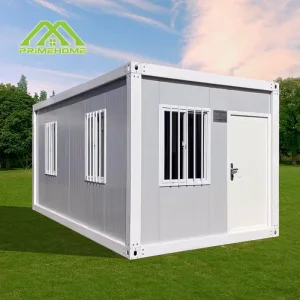
Our expandable container houses utilize dual-wing synchronous folding technology. Transported as standard 20ft or 40ft ISO dimensions, the unit deploys laterally to expand internal usable space from 14.8 m² up to 36 m² (for 20ft expandable units) or 72 m² (for 40ft units) in under 30 minutes.
Heavy-duty steel hinges equipped with self-lubricating composite bushings guarantee 5,000+ deployment cycles without structural deformation. Integrated EPDM triple-lip continuous gasket systems provide airtight seals, easily passing German Blower-Door airtightness testing (n50 < 1.5 h⁻¹).
Structural Steel Matrix (DIN EN 10025-2)
- Main Frame: Cold-formed 3.5mm-4.0mm Q355B Galvanized Structural Steel Profiles.
- Roof Load Capacity: Engineered for 1.8 kN/m² snow loads (Zone 2/3 Germany).
- Wind Resistance: Rated up to Beaufort Scale 11 (120 km/h wind pressures).
- Seismic Rating: Seismic performance up to Zone 8 intensity.
German & Global Commercial Sanitation Market: Container Toilet Innovations
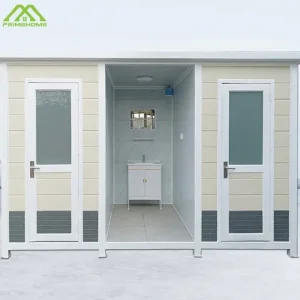
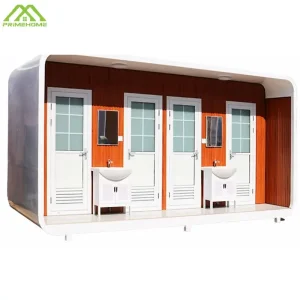
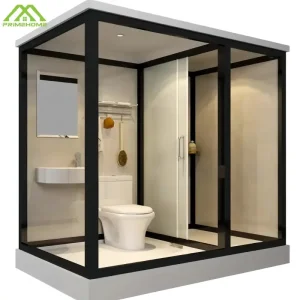
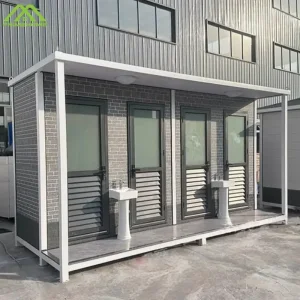
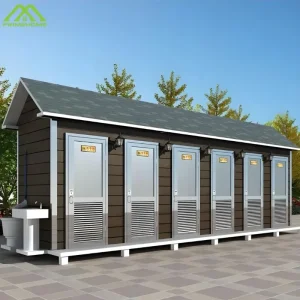
The commercial sanitation sector across North Rhine-Westphalia, Bavaria, and major German infrastructure nodes has shifted rapidly toward self-contained modular container toilet systems. Conventional plastic porta-potties are increasingly banned at long-term German municipal job sites due to strict workplace hygiene regulations (Arbeitsstättenverordnung - ArbStättV) and strict environmental protection standards.
ArbStättV Hygiene Compliance
German law mandates climate-controlled, illuminated, hot-water-equipped sanitary facilities for construction crews exceeding 10 personnel. Container toilets provide modular washrooms with integrated heating, mechanical ventilation, and anti-slip R11 DIN 51130 rated flooring.
Barrier-Free DIN 18040-1 Standards
Public sector installations in Berlin, Munich, and Hamburg require wheelchair-accessible public WC containers. Our custom container toilets offer zero-threshold ramps, emergency call buttons, magnetic locks, and broad turning radii complying with German accessibility codes.
Eco-Sanitation & Greywater Management
Equipped with low-flow vacuum flush systems and optional membrane bioreactor (MBR) micro-filtration tanks, our container toilets reduce fresh water consumption by up to 65%, permitting off-grid deployment in protected German natural reserves.
Deploying Expandable Containers Across Diverse German Regions
From the humid coastal ports of the Baltic to the sub-zero winter environments of the Bavarian Alps, modular prefabrication solves key regional challenges.
Eco-Glamping & Winter Tourism
High thermal insulation (PIR wall cores) combined with floor heating systems permits rapid setup of luxury expandable holiday villas in sensitive alpine terrain without deep concrete foundations.
Industrial & Site Management
Large-scale infrastructure projects require fast, stackable modular offices and worker housing camps. Expandable units maximize floor area while reducing freight volume from port hubs.
Maritime Commercial Units
Maritime administrative hubs utilize corrosion-resistant C4H painted container offices capable of withstanding aggressive salt-spray environments and high coastal winds.
Urban Pop-Up & Public WC
Metropolitan regions leverage quick-deployment container toilets and modular retail pop-ups to optimize underutilized urban spaces without disrupting city infrastructure.
German Supply Chain, Certification & Direct Technical Support
We provide seamless B2B manufacturing support, custom export logistics via Hamburg/Bremerhaven, and rigorous quality assurance.
End-to-End European Quality Assurance
To guarantee frictionless customs clearance and regulatory approval under German building authorities (Prüfstatik), all manufacturing procedures are certified under ISO 9001:2015 and ISO 14001:2015. Electrical layouts include pre-installed CE-marked conduit cabling, Schneider/ABB breakers, FI-Schutzschalter (RCD protection switches), and IP65 wet-room sanitary ratings.
Our engineering team collaborates directly with German architects, freight forwarders, and procurement managers to provide customized CAD blueprints, BIM models, and 3D structural analysis prior to mass production.
Consult Our Engineering DirectorKey Certification Compliance Matrix
Technology Roadmap: Next-Gen Modular Infrastructure
Pioneering smart, energy-positive expandable containers and circular sanitation systems for modern Europe.
BIM Level 3 Integration
Full IFC digital twin modeling for seamless inclusion into German municipal urban planning and CAD workflow systems.
BIPV Solar Roofing
Integrated lightweight monocrystalline photovoltaic roof membranes turning expandable containers into energy-net-positive units.
AI Climate Control
Embedded Smart IoT sensors managing heat recovery ventilation (HRV) and predictive energy conservation during extreme German winters.
Zero-Waste Water Recirculation
Closed-loop biological greywater treatment inside portable container toilets for complete municipal off-grid compliance.
Frequently Asked Questions for German Importers & Contractors
In-depth technical answers addressing regulatory compliance, shipping logistics, structural durability, and custom interior options.
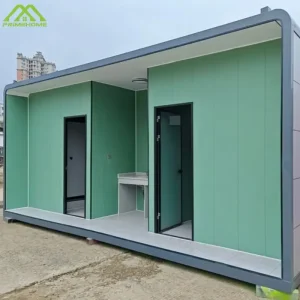
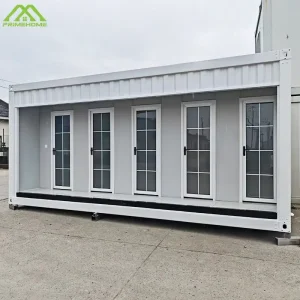
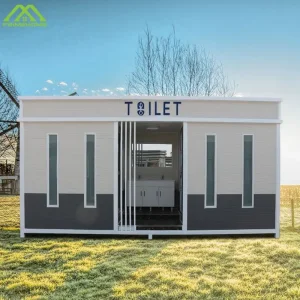
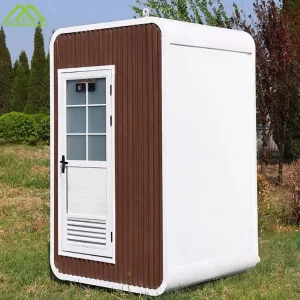
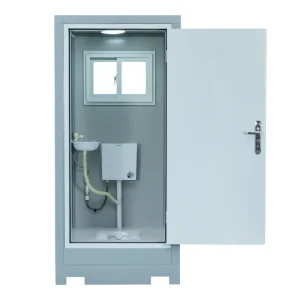
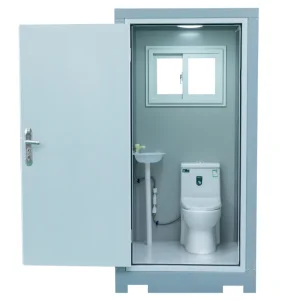
Expanded Container Toilet & Prefabricated Sanitation Units
Factory-direct mobile restrooms, modular bathrooms, and rapid sanitary container systems engineered for European deployment.
Partner with a World-Class Modular Prefabrication Manufacturer
Whether you are developing modular residential communities, sourcing commercial container toilets for municipal tenders, or importing expandable container units into Germany, our engineering team delivers precision, compliance, and direct factory pricing.