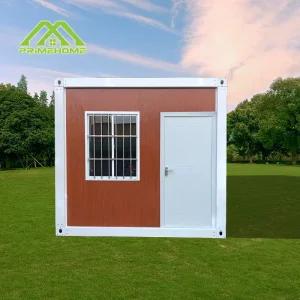
Factory Inventory
High-Efficiency Modular Solutions for Construction Logistics
Explore our export-ready modular units deployed globally across megaprojects, commercial builds, and heavy-industry sites.
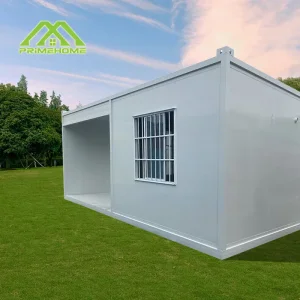
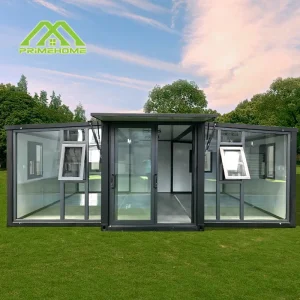
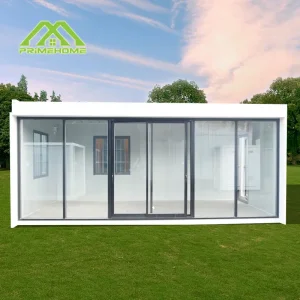
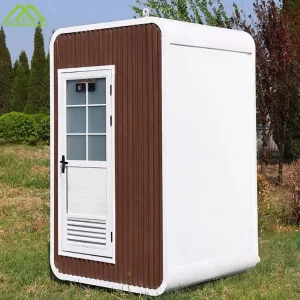
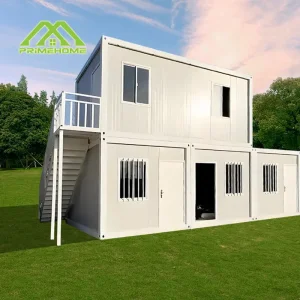
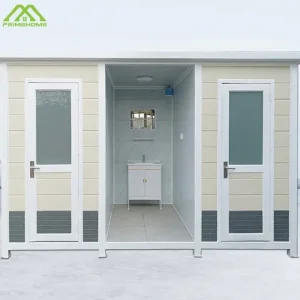
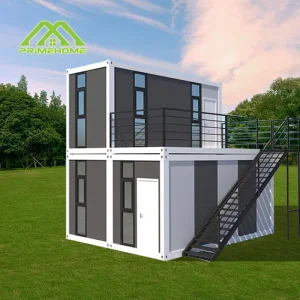
Macro Industry Solutions
The Paradigm Shift in Construction Site Infrastructure
Global infrastructure initiatives, energy transition megaprojects, and urban development demand rigorous jobsite logistics where speed, worker safety, and environmental stewardship converge.
Capital Velocity & Rapid Commissioning
Traditional stick-built site encampments induce substantial schedules, extensive local permitting hurdles, and weather-dependent construction lags. China industrial container manufacturers deliver turnkey plug-and-play modular encampments, shortening site establishment timeframes by up to 70% while drastically decreasing on-site labor overhead.
Circular Economy & ESG Alignment
Modern ESG criteria penalize construction projects generating tons of timber waste and single-use site offices. Modular container housing operates on a closed-loop zero-waste framework: units are 100% relocatable, withstand dozens of disassembly-assembly lifecycles, and employ recyclable galvanized structural steel profiles.
Structural Resilience & Worker Welfare
Worker productivity is intimately linked to onsite living standards. Suzhou PrimeHome Technology structures its site containers with high-density rockwool and polyurethane sandwich panel cores, delivering fire resistance classes (A-Grade), high acoustic isolation (STC 40+), and thermal efficiency in ambient ranges from -40°C to +50°C.
Market Dynamics
Global Commercial & Industrial Landscape
A rigorous review of how diverse global territories utilize Chinese prefabricated modular solutions to resolve pressing infrastructure bottlenecks.
North America: Tier-1 EPC Megaprojects
Driven by the CHIPS Act, renewable energy corridors, and battery gigafactories, North American contractors deploy scalable double-wing expandable containers and flat packs to establish 1,000-man operational headquarters within days of ground-breaking.
European Union: Net-Zero Encampments
Strict energy efficiency directives (EPBD) dictate tight thermal envelopes for construction offices. PrimeHome supplies CE-compliant, thermal-bridge-free modular containers featuring integrated rooftop photovoltaic arrays and graywater recycling container sanitary blocks.
Middle East & GCC: Extreme Heat Operations
From Neom to massive desert civil works, regional contractors require structural stability under intense UV, sandstorms, and +50°C heat. Heavy-gauge galvanized frames with fluorocarbon exterior coatings and specialized HVAC routing ensure continuous site uptime.
Australia & Oceania: Remote Mining Hubs
BHP, Rio Tinto, and tier-1 mining operations require cyclone-rated (Region C & D AS/NZS 1170.2) modular worker accommodations. Chinese manufacturing ecosystems provide customized flat-pack systems meeting BCA/NCC compliance protocols cost-effectively.
Engineering Comparison
Modular Building Typologies: Site Efficiency Analysis
Selecting the optimal container housing framework requires balancing shipping cube metrics, crane dependencies, and onsite commissioning speeds.
| Building Typology | Shipping Footprint (40HQ) | Onsite Erection Speed | Wind & Seismic Rating | Primary Industrial Use Case |
|---|---|---|---|---|
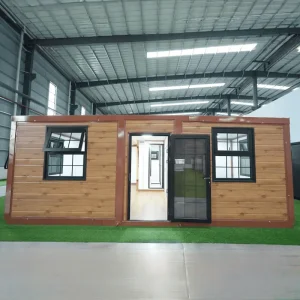
| Double-Wing Expandable House | 1-2 Complete units / 40HQ | 15 mins / 2 workers | Wind: 120 km/h | Seismic: Grade 8 | Executive offices, medical stations, luxury camp suites |
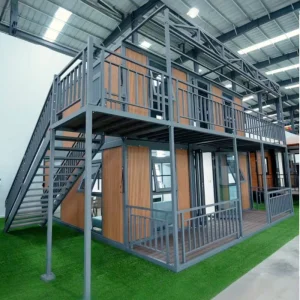
| Flat-Pack Modular Container | 6-8 Stacked units / 40HQ | 2 hours / 3 workers | Wind: 130 km/h | Seismic: Grade 8 | High-density worker dorms, multi-story site complexes |
| Z/X-Foldable Container House | 10-12 Folded units / 40HQ | 4 mins / Crane + 2 workers | Wind: 100 km/h | Seismic: Grade 7 | Rapid disaster relief, emergency workforce deployment |
| Detachable Knock-Down Cabin | Up to 15 sets in parts / 40HQ | 4 hours / 2 workers | Wind: 110 km/h | Seismic: Grade 7 | Remote infrastructure projects with minimal crane access |
| Turnkey Apple Cabin / Pod | Fully finished / 40FR flat rack | Instant plug-and-play | Wind: 140 km/h | Seismic: Grade 9 | Client reception centers, project showrooms, VIP lodging |
Compliance & Quality
International Regulatory Compliance & Engineering Assurance
Navigating cross-border codes requires an engineering team fluent in ASTM, Eurocodes, AS/NZS, and international sanitary standards.
Structural Integrity & Cold-Formed Steel
Every PrimeHome chassis utilizes high-strength Q235B / Q355B hot-dip galvanized steel cold-formed profiles. Joints undergo robotic laser cutting and submerged arc welding, inspected via ultrasonic non-destructive testing (NDT) to prevent structural fatigue under extreme cyclical crane lifts.
Global MEP Standardization
Electrical and plumbing installations are engineered to destination nation rules: UL/CSA-listed wiring, conduits, and breakers for North America, CE/EN-compliant circuits for Europe, and SAA-certified pre-wiring for Australasia. Pre-installed PEX-b piping ensures leak-free sanitary integration.
Fire Engineering & Life Safety
We configure wall systems using non-combustible Grade-A rockwool insulation (density 100-120 kg/m³) achieving up to 120 minutes of fire resistance under ISO 834 standard heating curves. Integrated emergency push bars, smoke alarms, and safety glass are standard factory provisions.
Operational Deployment
Localized Turnkey Jobsite Scenarios
From central urban infrastructure to remote off-grid mining, modular construction site units adapt seamlessly to complex workflows.
Mega-Scale EPC Worker Accommodation Cities
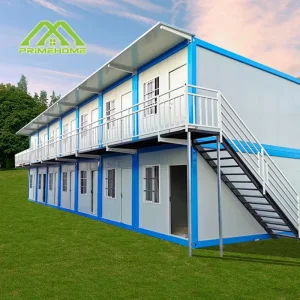
Stackable flat-pack and double-wing expandable modules form high-capacity residential hubs complete with sleeping quarters, commercial kitchens, walk-in cold rooms, recreation halls, and full medical triage clinics for multi-year dam, port, or pipeline construction.
Smart Jobsite Management & BIM Command Centers
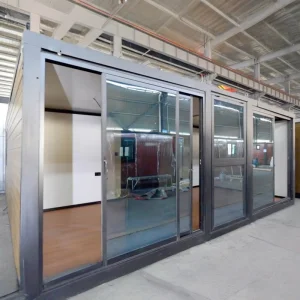
Configured with acoustic wall paneling, perimeter cable management, and floor-to-ceiling panoramic double-glazed observation glass, these units serve as high-tech operational command centers overseeing drone surveying, BIM coordination, and automated logistics.
Rapid Incident Command & Containment Pods
When unexpected natural events or biological hazards interrupt infrastructure projects, foldable units convert into pressurized clean rooms, mobile testing labs, or emergency sheltering camps, deployable from flatbed trucks in less than ten minutes per structure.
Next-Gen Prefab
Technology Roadmap: The Future of Site Containers
Suzhou PrimeHome Technology is steering modular construction into an era characterized by AI-assisted thermal modeling, automated robotic chassis welding, and self-sustaining energy modules.
Self-Sustaining Solar & BESS Integration
Developing lightweight flexible perovskite solar laminates directly bonded to ribbed roof decking, paired with integrated Lithium Iron Phosphate (LiFePO4) storage to power temporary jobsite offices completely off-grid.
IoT Predictive Climate Optimization
Embedded thermal sensors and automated air exchange dampers mitigate condensation issues in sub-zero or humid regions, optimizing energy expenditure across 100+ module worker colonies through a single cloud dashboard.
Automated Aerogel Insulation Layers
Progressively replacing conventional mineral wool with silica aerogel composite paneling, achieving R-values exceeding R-40 in slim 50mm wall thicknesses, vastly increasing interior net square footage while preserving heat retention.
Digital Twin & Automated BIM Factory Lines
Transitioning all custom jobsite bids to automated Revit-to-CNC assembly frameworks, reducing pre-engineering lead times from 14 days down to 48 hours for complex, multi-story modular site offices.
Procurement & Technical FAQ
Frequently Asked Questions by Global Contractors
Essential guidance covering international shipping, foundation requirements, custom engineering, and factory-level guarantees.
What foundation specifications are required for temporary site containers?
Due to their self-supporting rigid structural steel frame, container units do not demand expensive full-slab concrete foundations. For temporary deployments, level compacted gravel, concrete pad blocks placed at corner posts, or simple ground helical screw piles provide sufficient bearing resistance, minimizing site restitution costs upon project handover.
How does China factory production guarantee corrosion resistance in marine/saline zones?
Suzhou PrimeHome applies a multi-stage surface protection protocol. Structural hollow sections undergo chemical pickling, hot-dip galvanization with a minimum zinc coating thickness of 180-275 g/m², followed by an electrostatic powder coating or marine-grade C4/C5 polyurethane finish, guarding against rust during ocean transport and harsh coastal site service.
How are sanitary waste lines and plumbing handled in modular site restrooms?
Our container toilets and mobile sanitary blocks feature fully factory-plumbed drain networks routed to standard exterior flanged discharge ports. They readily link to local municipal sewers, holding tanks, or self-contained chemical treatment macerator systems, ready for activation within hours of hookup.
What is the actual production capacity and typical export lead time?
Our 28,000 m² Suzhou manufacturing facility maintains a monthly throughput capacity surpassing 5,000 standardized units. Standard flat packs ship within 10-15 business days, while highly customized multi-room camp configurations or expandable villas are fabricated, packed, and sea-freight dispatched in 20-30 days.
Factory Catalog
Commercial Prefabricated & Expandable Housing Range
Direct supply from Suzhou PrimeHome Technology Co., Ltd. for contractors, resort managers, and global procurement houses.